
Science Writing: Wisdom of the Wild

In our Science Writing series, we’re sharing articles, stories, and more that students have created at UWA. Each post starts with a quick rundown of what it’s all about—our purpose, audience, and messagetying it all back to the basics of science communication!
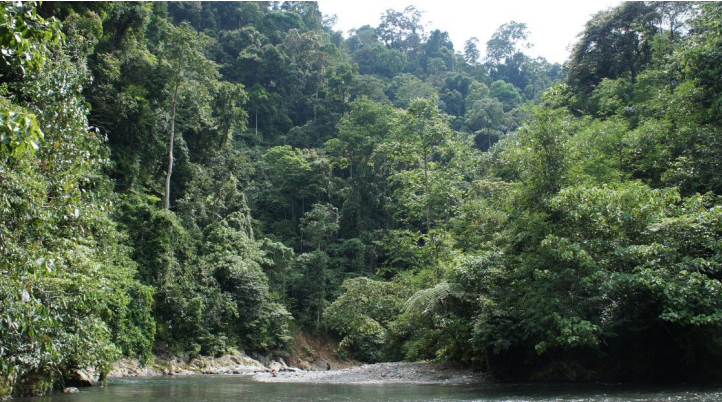
Gunung Leuser National Park in North Sumatra, Indonesia. Dennis Keller, CC BY-2.0

“This feature article was written for UWA’s SCOM2208 Science Writing unit in a similar style to a Cosmos article. It is about Rakus the orangutan, who was observed in the wild self-medicating with a medicinal plant. I aimed to blend scientific rigour with an engaging narrative style to capture readers’ interest. Recognising Cosmos’s educated audience and typical grade 11–13 readability level, I balanced complex sentence structures with minimal jargon. Descriptive language and imagery immersed readers in Gunung Leuser National Park, while insights from Dr. Isabelle Laumer added professional authority. By humanising Rakus and linking his behaviour to broader anthropological and evolutionary contexts, I invited readers to draw parallels between orangutans and humans, highlighting both the remarkable intelligence on display and its deeper implications.” 

– Anna Balaguer

Wisdom of the Wild: First recorded case of a self-medicating orangutan

By Anna Balaguer

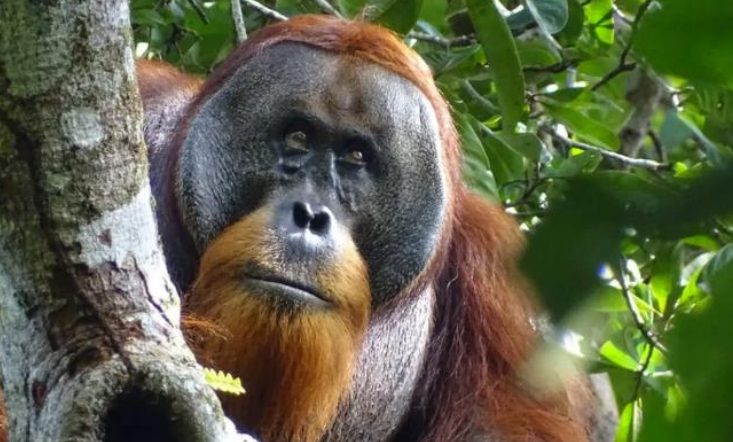
Rakus the orangutan was found with an alarming wound on his face. What he did next surprised and amused researchers. 

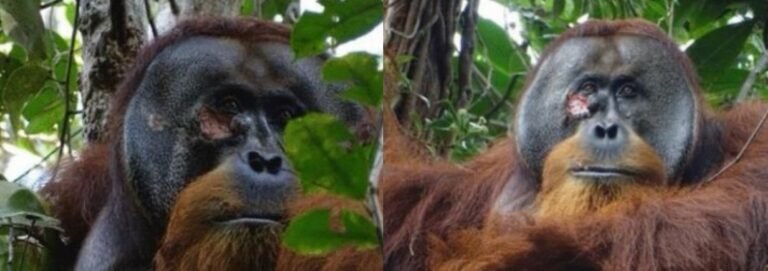
Rakus with face wound. Saidi Agam, CC BY-NC 4.0

Deep within the lush forest of Gunung Leuser National Park in Indonesia, a male Sumatran orangutan named Rakus moved stealthily among the trees, his rust-coloured coat striking against the green canopy below.

As he turned his dish-shaped head, an alarming wound was revealed. A gaping cavity marred his right cheek where a large chunk of flesh had been torn away, leaving behind a raw, bleeding groove of exposed flesh. Exactly how Rakus acquired such a gruesome injury was unknown. He likely received it in a fight for dominance against another male. But with such a severe wound, Rakus was at high risk of developing infections and other potentially life-threatening complications.

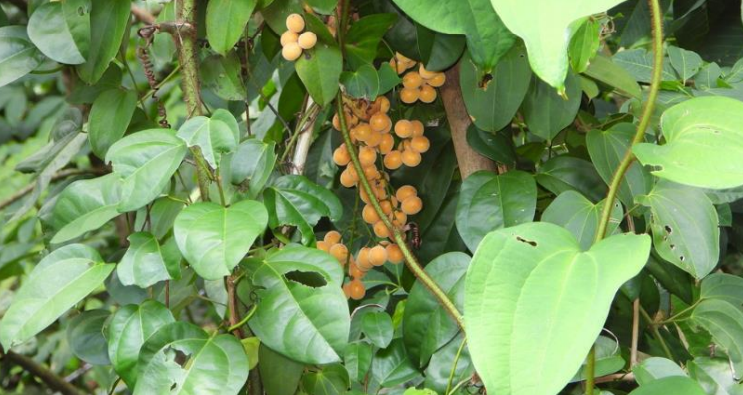
Days later, Rakus was seen purposefully foraging on the leaves and stems of Fibraurea tinctoria, a common vine plant. Also called akar kuning, this plant is known to have many medicinal properties by local people, who use it for pain relief.

'Fibraurea tinctoria'. Catalina Tong, CC BY-NC 4.0

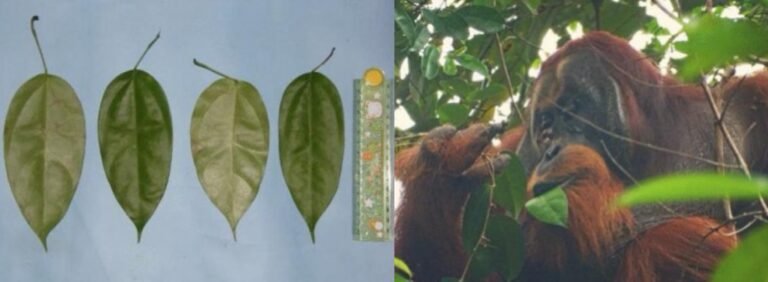
Not commonly eaten by orangutans, the unassuming vine seemed a peculiar choice for a great ape. But Rakus persisted. After feeding on the plant for several minutes, he curiously began to chew on the leaves without swallowing. Then, using his fingers, Rakus precisely smeared the juices from the plant into his open wound. As flies began to settle around his lesion, he spread a plaster of mashed leaf on the wound, masterfully crafting a protective covering. Once satisfied with the dressing, Rakus continued to feed on the plant for half an hour.

Left: Pictures of 'Fibraurea tinctoria' leaves. Right: Rakus feeding on 'F. tinctoria', aka akar kuning, leaves. Saidi Agam, CC BY-NC 4.0

In a matter of days after being seen using this plant, Rakus’ lurid wound was fully closed. One month later, it was barely visible.

Rakus fully healed, one month after he was seen using 'Fibraurea tinctoria'. Saidi Agam, CC BY-NC 4.0

What was seen in Rakus’ behaviour with the akar kuning plant was unique: the first recorded instance of a wild animal deliberately using a plant containing medicinal compounds to treat its own wounds. Researchers had been observing Sumatran orangutans in this park for 21 years, and in all that time, this was a first.

Rakus’s use of the medicinal plant raises numerous intriguing questions that researchers must explore to gain a full understanding of the situation.

The first mystery to solve is whether Rakus knew what he was doing. Were Rakus’s actions a series of random, thoughtless coincidences, or was it deliberate? To answer this question, researchers pointed to several of Rakus’s indicating behaviours.

“We think that this behaviour was intentional,” announced Dr Isabelle Laumer, a primatologist who co-wrote a paper on the study, “because he repeatedly applied the plant sap over and over again for seven minutes and he also applied the more solid plant matter on top of the wound. He also did that for an extended period of time.” The repetitive and prolonged nature of his behaviour made it hard to chalk his actions up to coincidence. Beyond that, researchers also pointed to the fact that he left the rest of his healthy body untreated, suggesting purposefulness in his behaviour.

But did Rakus know prior to using it that this plant would help him? How did this behaviour emerge? The researchers studying Rakus’s behaviour have developed a couple of theories.

It is possible that Rakus could have essentially invented using this plant as a medicine. He may have touched his wound while feeding on Fibraurea tinctoria by chance, and unintentionally applied the plant’s juice to his wound. Upon immediately realising the potent pain-relieving effects of the plant, he could have repeated these actions to ensure a continuation of his pain relief. This behaviour would be an example of accidental individual innovation.

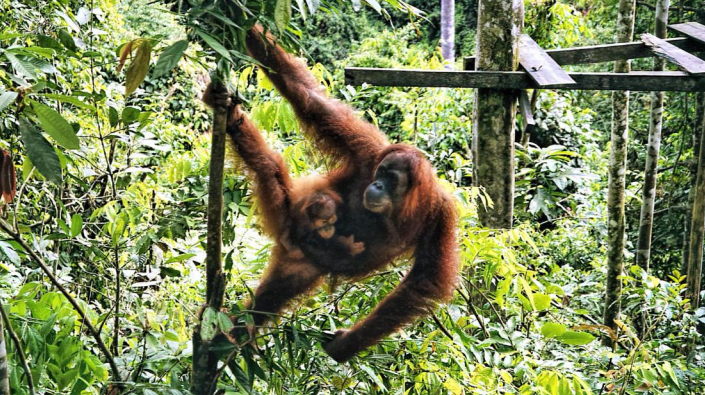
A mother orangutan with her baby, Dan Lundberg, CC BY-2.0

Another explanation could be that this is a learned behaviour through cultural transmission. Immature orangutans rely on observational social learning to develop their skills.

“The orangutans in his birth area might show this behaviour. Maybe he learned it from his mother or another orangutan, and then later applied the behaviour himself when he was injured,” explained Dr Laumer.

Male orangutans disperse far from their natal area around puberty. Rakus was not born in Gunung Leuser National Park, and researchers have no idea where he came from. But following this theory, it’s possible that in Rakus’s natal community this behaviour is common, and the idea is well spread amongst individuals in that population.

“We don’t know if we observed individual innovation or even if he had learned that behaviour in the past,” said Dr Laumer.

But regardless of its origins, Rakus’s use of the medicinal plant demonstrated self-awareness, problem-solving capability, and perhaps even cultural transmission of knowledge within orangutan societies. This observation challenges conventional assumptions about ape intelligence and raises questions about the potentially underestimated cognitive abilities of non-human primates.

On a larger and more anthropocentric scale, Rakus’s self-medicating behaviour might also represent a window into the shared evolutionary roots of human and great ape cognition.

Anthropologists theorise that the regular consumption of bitter plant compounds by our primate ancestors laid the foundations for the use of medicinal herbs and botanicals in early human societies. Just as Rakus demonstrated problem-solving and self-awareness in using the medicinal plant, our early human ancestors learned to harness plant materials to treat ailments and promote recovery.

This fundamental behaviour, rooted in our common evolutionary past with great apes like orangutans, was the beginning of what would become sophisticated human medical knowledge. Over millennia, as the sharing of information between individuals and across generations aided cultural transmission, this knowledge of medicinal plants grew increasingly complex, giving rise to traditional medicine practices we still observe today.

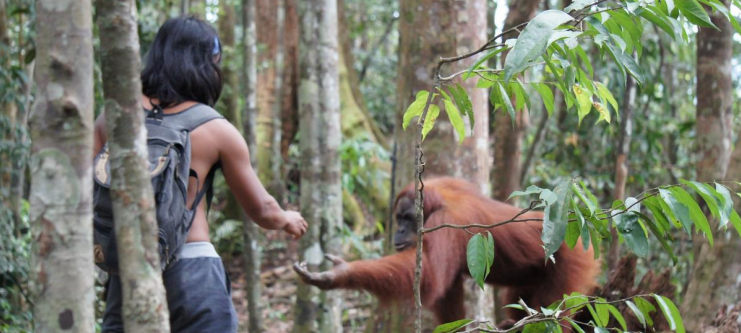
Gunung Leuser & Orangutans, Dennis Keller, CC BY-2.0

As the scientific community continue to unravel this mystery, Rakus’s remarkable actions have shattered assumptions about the cognitive gulf between humans and other primates. By understanding their minds and behaviours, we may ultimately uncover deep insights into the origins of our own consciousness and intelligence.

For now, Rakus continues to explore the beautiful, vast jungles of Gunung Leuser National Park, fully healed and fully unaware of the questions he has inspired through his actions of self-care.

Anna Balaguer

Hello, thank you for reading my article! I'm Anna, an undergrad student majoring in Zoology and minoring in Science Communication. My main areas of interest lie in understanding the evolutionary reasons behind the appearance of an animal, especially the contrast between practical adaptations that help the animal survive, and the often extravagant traits driven by sexual selection. I think that nature is an inexhaustible vault of weird and wonderful stories, so my work in SciComm is about putting these marvels into words for people to enjoy!

In my free time I love wandering around flipping over logs and digging through soil to find cool insects, and when I'm not doing that, I'm probably working my way through the extensive list of Toho Kaiju movies (there's over 50).

More from our blog...

Questions? Comments? Leave A Reply Here!

Share your thoughts

Your email address will not be published. Required fields are marked *

This site uses Akismet to reduce spam. Learn how your comment data is processed.

Two white conversation bubbles with a yellow play button in the middle, with the words, "The SciComm Collective" below the logo
A black swan against a brushstrokes of yellow and blue
Swan Cultural Learning by Dr Richard Walley

Acknowledgment

We acknowledge, with respect, the Whadjuk people of the Noongar Nation as the Traditional Custodians of the land on which we work and produce The SciComm Collective, and pay our respects to Elders past and present. We extend our respect to all Aboriginal and Torres Strait Islander peoples.

All opinions on this website are representative of individuals and are not representative of The University of Western Australia. The University of Western Australia is not liable for content herein.