What do you do when you have your audience right in front of you?
For those of us in science communication, Open Day was a live-action stage to put the “Purpose, Audience, Message” (PAM) mantra into practice. Our primary goal this year was pretty ambitious: to raise awareness of the discipline beyond our current SCOMmunity.
It feels easier to talk to people who already know science communication, but how do you reach the people who haven’t yet realised that science communication is what they’ve been looking for?
For so long, UWA Science Communication has felt like a hidden gem. Dr Heather Bray, our beloved Discipline Chair, decided that “hidden” was no longer an option, not on Open Day.
Her first step was an inflatable peacock outfit.
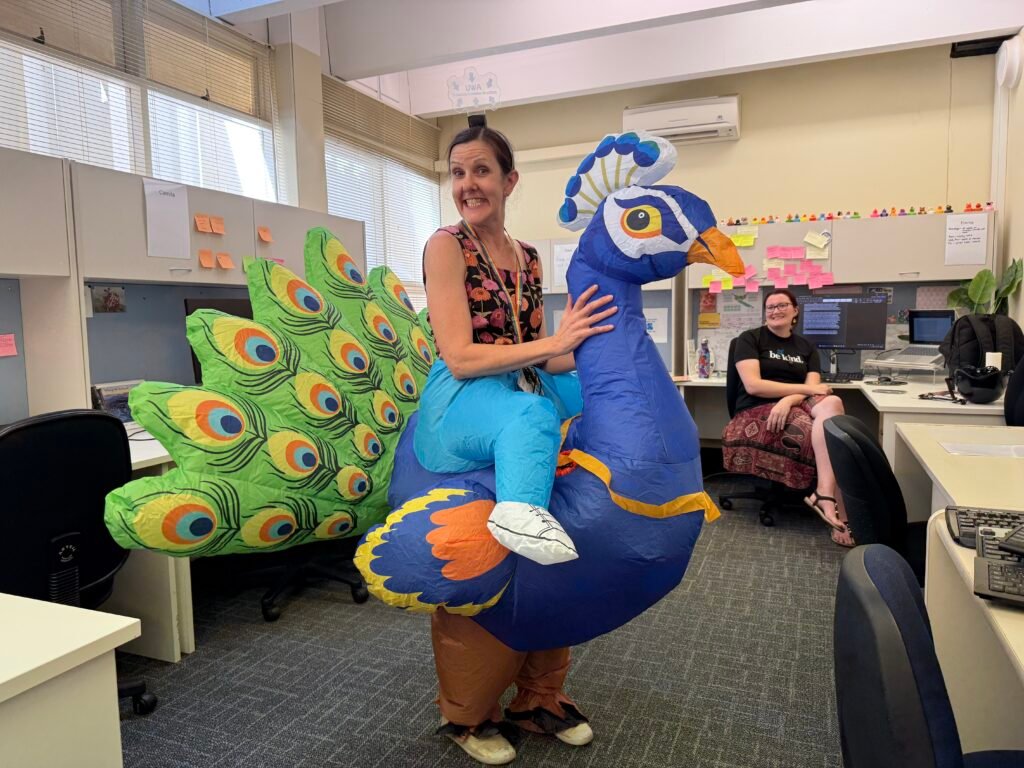
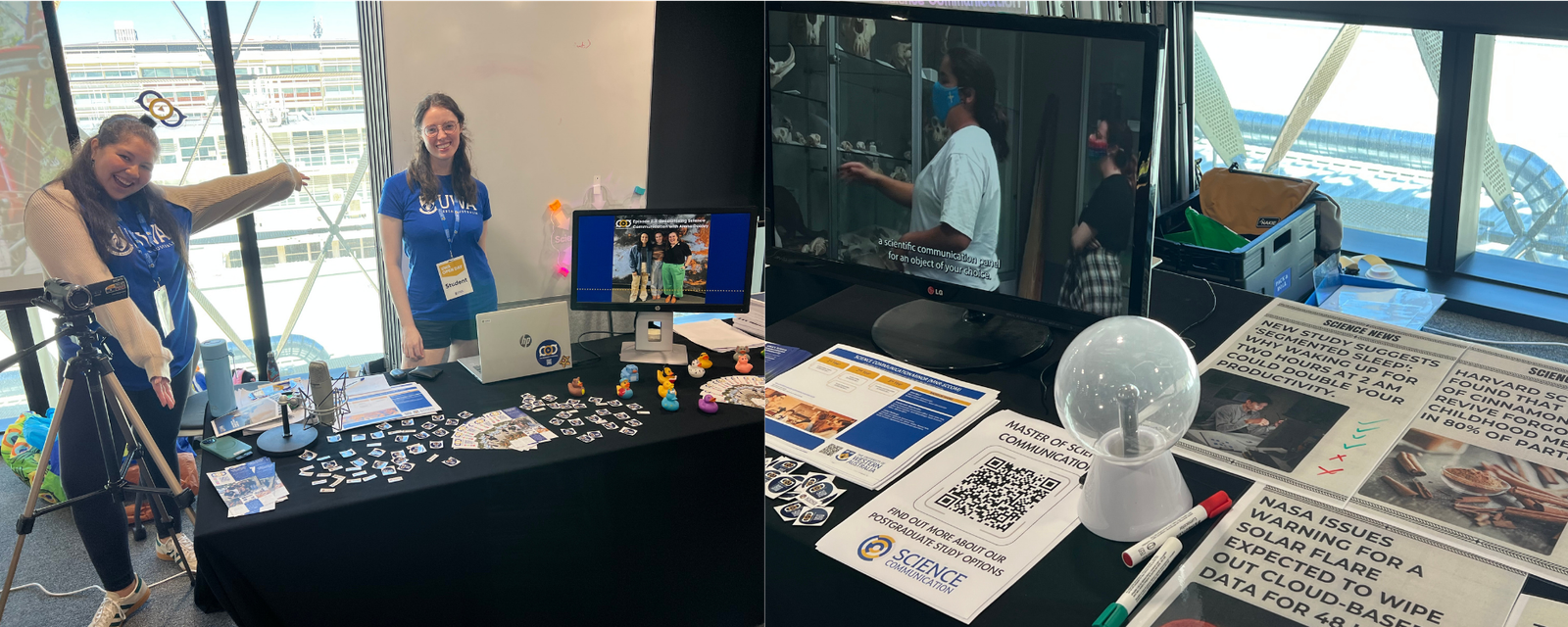
Once we had people’s attention (thanks to the peacock and the glowing signs), the next challenge was keeping it. In the spirit of PAM, we wanted our table to be more than just a place to pick up a flyer. We wanted it to be a space for active participation.
To do this, we leaned into two specific interactives: one SCOMmunity classic, and one new experiment born from my own literature review.
The “How do you like your science?” Poll
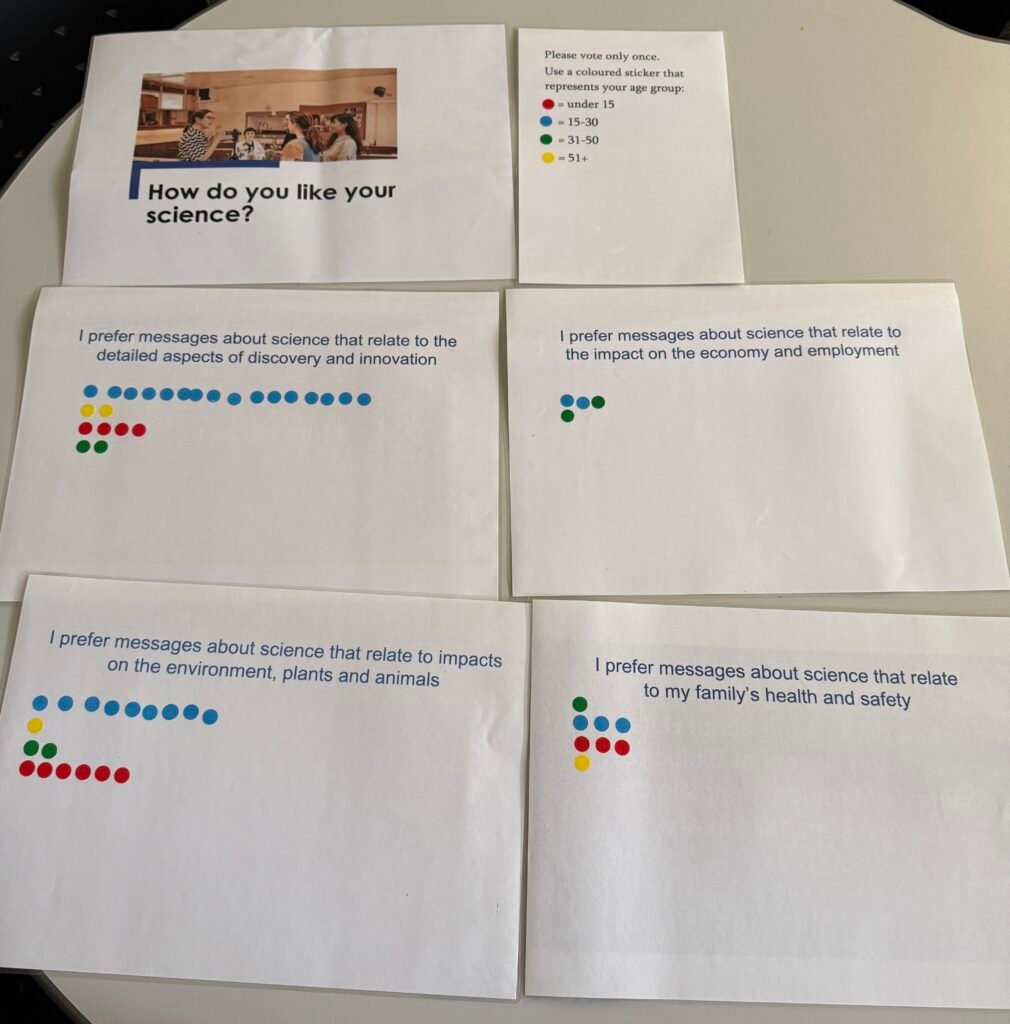
We decided to keep a favourite from previous years: a simple but effective sticker-dot poll. We asked visitors to categorise themselves by age and vote on “How do you like your science?”
The purpose here was twofold: it gave us an immediate visual data set of our audience’s preferences, and it served as an icebreaker to talk about all kinds of different perspectives and concerns about scientific information.
The “Shareability” Experiment
For our second interactive, I made a conscious choice to retire our old “Spot the Fake News” headline game, because that activity is a classic example of the Deficit Model in action.
The Deficit Model assumes that if people just had more facts or better literacy, they would naturally make better decisions. But as we know in science communication, simply filling a knowledge gap rarely changes behaviour. People don’t usually share fake news because they are “fooled” by it, they share it because of how it makes them feel.
I decided to experiment with something adapted from my literature review last year (yes, I have zero shame in repurposing my own assignments). My research started with an even older case study on how easily misinformation spreads when media platforms prioritise engagement over accountability.
It got me thinking: What actually triggers the urge to share?
My conclusion from that literature review confirmed that on platforms like TikTok, accuracy doesn’t rank particularly high on the list of reasons people engage with something.
Instead, misinformation thrives because it is:
On TikTok, every interaction, even a comment meant to debunk a claim, is treated as engagement. The algorithm doesn’t care if a video is “true,” it only cares if you engage.
This systemic bias toward interaction over accuracy became the driving force behind my purpose for designing the activity. If the algorithm doesn’t care about the factual accuracy, then our message shouldn’t just be about correcting people, it should be about revealing the invisible hooks that motivate us to click.
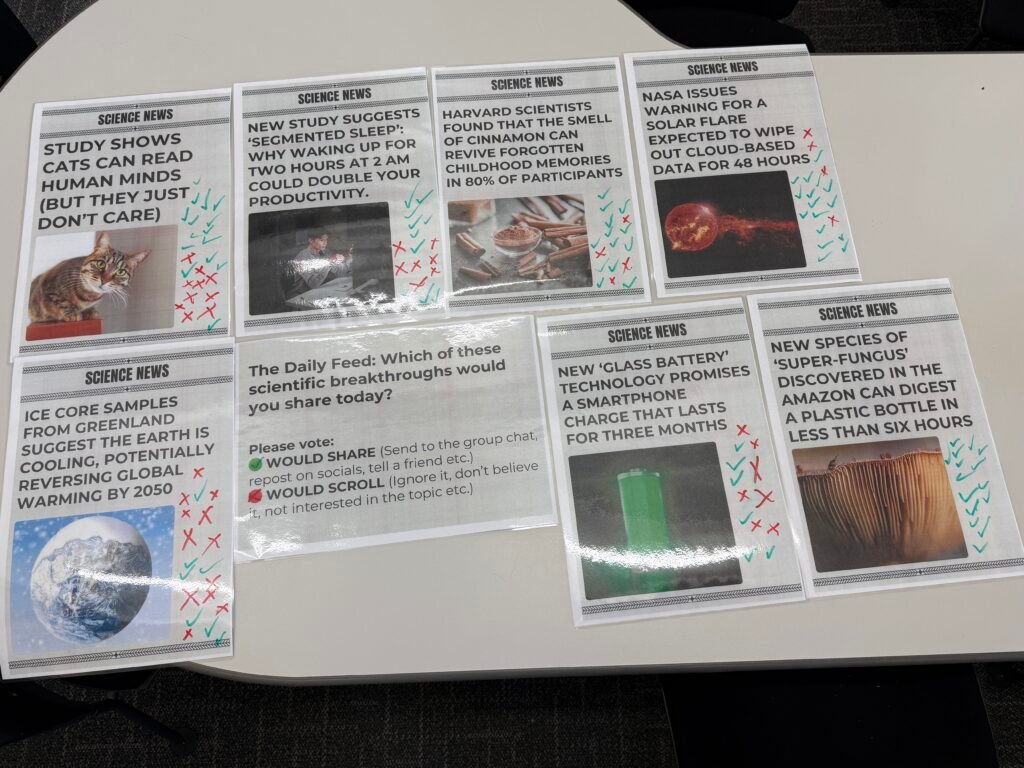
To bring this into the “real world” on Open Day, I used Gemini to generate a list of entirely fabricated science news headlines. But instead of asking our visitors “Is this true?”, I asked them: “Would you share this if you come across it online?”
The goal was to shift our message from a lecture on accuracy to a conversation about sharing motives. By asking why a headline might be shareable, we were able to start a conversation about the algorithmic system that equates human interaction with content value. It allowed us to chat about how the most compelling content, rather than the most accurate content, is what ultimately gets amplified on social media.
In the end, I reminded every participant that science communication is far more than just translating research papers or providing FAQs. It is the study of the social dimensions of science. By investigating what our audience truly concerns themselves with and tailoring our message for them, we are essentially studying the intricacies of human society.
As the dust settles on another Open Day, our team has been reflecting on what worked, what surprised us, and where we go from here. It was a massive effort from everyone involved, especially in our push to promote the Minor in Science Communication since our audience consisted largely of prospective undergraduate students and their parents.
Even for those who weren’t looking to add a minor to their degree, we introduced them with The SciComm Collective, our student-led initiative. It’s a reminder that you don’t need to study a specific unit to be part of our SCOMmunity.
The Plasma Ball Paradox
Our table’s resident celebrity was, predictably, the plasma ball. It’s a classic for a reason—people can’t help but touch it. However, many people would engage with the ball but shy away from chatting about study options.
For next time, I believe better signage could help. A written label for the plasma ball, tailored to different readability levels, could turn a cool object into a conversation opener for discussing science communication in informal learning spaces (the GLAM/AquaBotParkZoo sector as Heather put it). It’s about meeting the audience where they are and giving them a reason to stay.
This leads to a bigger realisation. It’s undeniably hard to compete with compete with a room full of microscopes, plants, plushie marine animals, and even live stick insects from other disciplines under the School of Biological Sciences.
But this “competition” should motivate us. Science communication is a relatively abstract concept compared to a physical specimen. Our challenge for the future is to design even better interactive activities that make scicomm just as tangible and captivating as a lab demonstration.
Room to Grow
Reflecting on our setup, a few notes emerged:
Finally, this Open Day reinforced why The SciComm Collective is so vital. It is uniquely positioned to develop connections across disciplines, ensuring that all kinds of voices are heard, and that our SCOMmunity stays diverse, vibrant, and most importantly, visible.
Our Greatest Asset
On a personal level, it has been a genuine pleasure to work and study alongside such a passionate, creative, and simply amazing group of people.
When we were discussing how to expand our reach, Heather mentioned something that stuck with me. She said her biggest asset is us, it’s every single person who makes up this SCOMmunity, and I couldn’t agree more.
By sharing the stories of our people, I hope we can reach a wider audience and show them exactly why it is a community worth joining.
After all, science gives us the ‘what,’ but it’s the people who give us the ‘why.’
Ke is completing her Master of Science Communication at UWA, with a specific interest in how information is shared and understood online. She's a lover of stories, whether in books, TV series, movies, or video games. She is also a proud cat person who believes everything is always better with a feline assistant nearby.
All opinions on this website are representative of individuals and are not representative of The University of Western Australia. The University of Western Australia is not liable for content herein.