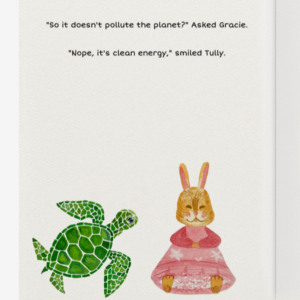
Ke Yuan sits down with Master of SciComm student Connie Greeve, author and illustrator of Gracie’s Energy Adventure.
KY: Hi Connie. Could you briefly introduce yourself and share what sparked your interest in science and storytelling?
CG: Hi, I’m Connie Greeve. I have a background in physics, but I’ve always cared more about talking about science than doing it. I love learning and believe that everyone deserves the chance to learn. My interest in storytelling stems from being an avid reader as a child.
KY: What inspired you to create a children’s book about alternative energy sources? How did you come up with the storyline and the characters?
CG: The book started as a Uni assignment that I put way more effort into than was necessary. I’ve always had a passion for our earth and educating about climate change, but I tend to find most communication on the subject very disheartening. I wanted to tell a story that was easy to understand but, more importantly, focused on a solution rather than the problem. The topic of renewable energy is more and more important in today’s society, so why should children be left out of the conversation? After all, they are the generation living with it.
I love baking and whimsy, so the storyline felt quite natural as I wrote. The character names are alliterative for no reason other than I like them.
KY: How did you decide which energy solutions to include in the story? Were there any fun or unusual sources you considered but didn’t end up using?
CG: The energy solutions came partly from necessity (coal being our largest energy source) and partly from the characters. I chose to explore common energy sources (coal and solar) because it was easier to juxtapose the underwater turbines with things the audience had already heard of. If the underwater turbines are the only ‘new’ source, then the reader has a better chance of remembering them. They were also based partly on the type of animal Gracie talks to, though what came first – the energy source or character – I’m not sure!
KY: Can you describe your illustration process? How did you combine visual storytelling with scientific concepts?
CG: All the illustrations are hand-painted watercolours (this was a bit of an over-commitment). I chose to illustrate the book for a few reasons, the first being that I enjoy painting. I also feel that a children’s book is not complete without visual interest. The illustrations also help the reader to grasp each character and follow the journey.
KY: How do you balance factual accuracy with creativity when writing a story intended to spark curiosity rather than deliver a textbook lesson?
CG: The point of the story is not to deeply explain how tidal energy can be harnessed using underwater turbines, but it’s also important to be accurate and truthful. I found that less is better when explaining how things work. When discussing coal and solar, I focused on only one of their limitations so that I could be accurate without overloading the science. I go slightly deeper into the workings of the underwater turbines because they are the main point. If each page has some science and some story, and the science informs the story, then I find it’s balanced.
KY: Were there any challenges you faced and how did you overcome them?
CG: When discussing the limitations of coal and solar, it was difficult to stick to a line or two because I had so much to say. I found the best way to overcome this was to focus on what the message of the book is, which is that ocean turbines are a clean, reliable, renewable source of energy. Anything else I had to say about the other sources just needed to juxtapose the turbines.
KY: As someone with a strong science background, how did your academic knowledge shape the narrative and artwork for this children’s book?
CG: My background is in physics, so my knowledge of energy and electricity allowed me to focus on the story without worrying about the science.
KY: What do you hope children (and parents!) will take away from Gracie’s story after they’ve turned the last page?
CG: At the very least, I hope they come away having read a fun book. Ultimately, I want it to facilitate discussions about electricity and the energy crisis we’re facing.
KY: Do you have any plans to continue writing or illustrating children’s books? What’s next for you?
CG: I’d love to do more children’s books. At the moment, it’s not my focus, but I hope I come to it in the future.
Gracie loves to bake for her friends, but when her oven stops working she has to find a new way to power her cooking. Gracie’s friends suggest all kinds of energy solutions… But which one will fuel Gracie’s baking and deliver her famous cupcakes?
A gentle introduction for young children on the benefit of alternative energy sources.

Connie is a freelance science communicator with a background in physics and science communication. She is currently completing her Master’s in Science Communication while collaborating with organisations like Pawsey and Einstein-First. When she’s not sharing her passion for science, she enjoys sewing, painting, and hunting for the most colourful finds in thrift stores.
All opinions on this website are representative of individuals and are not representative of The University of Western Australia. The University of Western Australia is not liable for content herein.